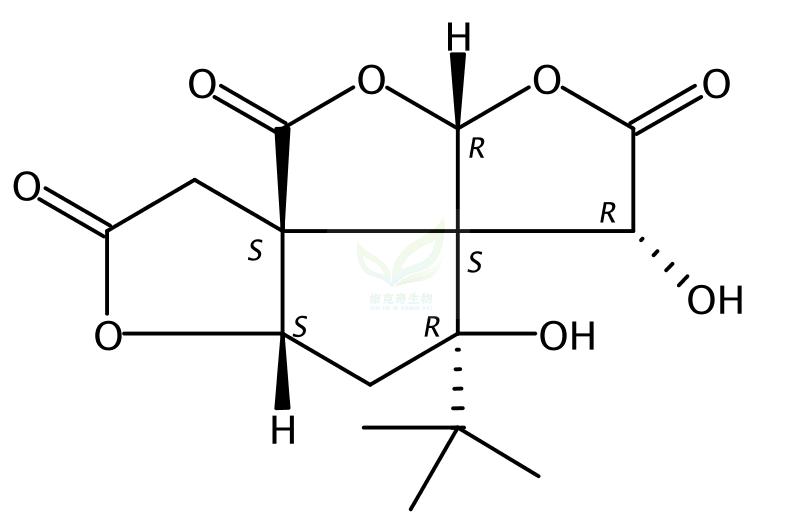
| Product Name | Bilobalide |
|---|---|
| CAS | 33570-04-6 |
| Formula | C15H18O8 |
| MW | 326.3 |
| Appearance | 白色粉末 |
| Boiling point | 651.7±55.0 °C | Condition: Press: 760 Torr |
| PKa | 11.74±0.40 | Condition: Most Acidic Temp: 25 °C |
| Product Name | Bilobalide |
|---|---|
| CAS | 33570-04-6 |
| Formula | C15H18O8 |
| MW | 326.3 |
| Appearance | 白色粉末 |
| Boiling point | 651.7±55.0 °C | Condition: Press: 760 Torr |
| PKa | 11.74±0.40 | Condition: Most Acidic Temp: 25 °C |
| Recyclable menthol-based deep eutectic solvent micellar system for extracting phytochemicals from Ginkgo biloba leaves | ||
| Source:SCI:Journal of Cleaner Production | Author:Li-Tao Wang | Notes:影響因子:6.395 |
| Reference description | ||
G. biloba leaves were purchased from Tong ren tang Chinese Medicine (Beijing, China) and were pulverized, sieved (40 mesh), and stored in a freezer at 4?°C until analysis. Reference standards (purity?≥?98%) were purchased from Sichuan Weikeqi Biological Technology Co., Ltd. (Chengdu, China). L-menthol (CAS: 1490-04-6) was purchased from Aladdin Bio-Chem Technology Co., Ltd. (Shanghai, China). | ||
| Separation and characterization of chemical constituents in Ginkgo biloba extract by off-line hydrophilic interaction × reversed-phase two-dimensional liquid chromatography coupled with quadrupole-time of flight mass spectrometry | ||
| Source:SCI:JOURNAL OF PHARMACEUTICAL AND BIOMEDICAL ANALYSIS | Author:Shuai Ji | Notes:影響因子:3.255 |
| Reference description | ||
The reference standards ginkgolide M (3), apigenin-7-O-glucoside (7), bilobalide (8), ginkgolide C (9), quercetin (14), luteolin (15), apigenin (16), kaempferol (17), isorhamnetin (18), ferulic acid (19), ginkgolide A (20), myricetin (22), genistein (23), chlorogenic acid (24), caffeic acid (26), luteolin-7-O-glucoside (33), kaempferol-3-O-glucoside (34), kaempferol-7-O-glucoside (35), quercetin-7-O-rhamnoside (40), isoquercitrin (45) and rutin (65) were purchased from Sichuan Weikeqi Biological Technology Co., Ltd. (Chengdu, China), and their structures are shown in Fig. 1. Purities of all the reference standards were over 98% according to HPLC-DAD analysis. | ||